> ## Documentation Index
> Fetch the complete documentation index at: https://docs.memanto.ai/llms.txt
> Use this file to discover all available pages before exploring further.
# Introduction
> Learn what Memanto is, how it works, and why it gives AI agents persistent memory.
# Memanto - Memory that AI Agents Love!
**Memanto** is a production-ready memory system for AI agents that gives them persistent, semantic long-term memory across conversations, sessions, and workflows.
## What Problem Does It Solve?
LLMs inherently lack persistent memory; they forget conversations between sessions. Agents need a way to:
* **Remember user preferences** across sessions
* **Track decisions and commitments** made during conversations
* **Store facts and context** for faster, smarter responses
* **Manage long-running workflows** with consistent state
* **Learn from interactions** over time
Memanto solves this with a semantic memory system built for AI agents.
## The 6 Principles of Production Agentic Memory
Based on our research and testing, we believe a robust memory system for AI agents should strive for six key characteristics:
1. **Queryable, not injectable**: Agents generally benefit from the ability to query memory based on relevance to the current task, rather than receiving a static blob of context injected at the start of a conversation. It's akin to giving an agent a librarian it can consult on demand versus a pre-assembled dossier.
2. **Temporally aware with decay**: Not all memories carry equal weight. A deadline mentioned yesterday often has a different urgency than a preference stated six months ago. We've found that memory works best when it supports temporal queries, versioning, and relevance decay signals.
3. **Confidence and provenance tracking**: A production system should ideally distinguish between explicitly stated facts, inferred patterns, and potentially outdated information. Providing provenance metadata helps agents calibrate their confidence and avoid making assertions on stale data.
4. **Typed and hierarchical**: Different kinds of memory (e.g., *episodic* for past conversations, *semantic* for facts about the world/user, and *procedural* for how to do things) serve fundamentally different retrieval purposes and typically benefit from being stored and queried with appropriate type semantics.
5. **Contradiction aware**: When new information conflicts with existing memory, the system should aim to flag the conflict rather than silently overwriting it. Left unchecked, unresolved contradictions can accumulate into "constraint drift," which may erode the coherence of the agent's world model over time.
6. **Zero overhead ingestion**: For real-time workflows, memory should ideally be available for retrieval immediately at write time, minimizing indexing delays, mandatory LLM extraction steps, and graph construction bottlenecks.
### How Memanto Solves These Challenges
Memanto is designed from the ground up to address these six principles:
* **Dynamic Retrieval**: Rather than relying on massive context windows, Memanto provides an active search layer, allowing agents to pull exactly what they need, when they need it.
* **Rich Metadata & Typing**: Every memory is stored with a specific **type** (e.g., `fact`, `preference`, `decision`) and a **confidence score**, providing the provenance and structure agents need to reason effectively.
* **Temporal Context**: Memories belong to specific sessions and timelines, allowing agents to distinguish between outdated assumptions and recent commitments.
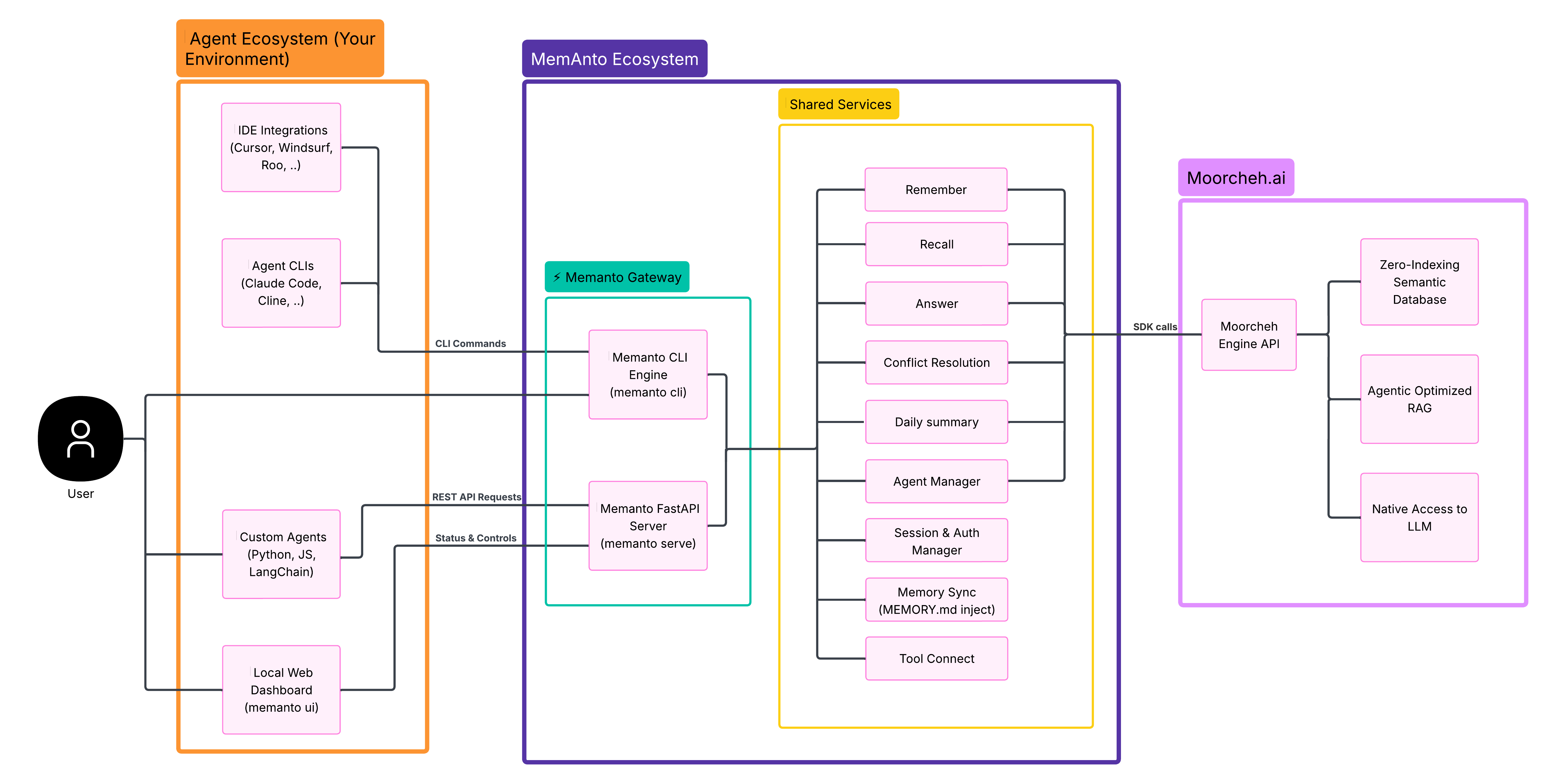
* **Instant Availability**: Because it is built on Moorcheh.ai (a no-indexing semantic database), Memanto eliminates the indexing delays of traditional vector databases. Memories are searchable the exact millisecond they are written.
## Key Advantages
### Zero-Cost Ingestion Latency
Unlike traditional vector databases that index after writes, Memanto uses **no-indexing semantic search**. Memories are available for retrieval **immediately** no waiting.
### State-of-the-Art Accuracy
Evaluated on LongMemEval and LoCoMo benchmarks:
* **89.8%** accuracy on LongMemEval
* **87.1%** accuracy on LoCoMo
### Semantic Search
Store memories with semantic meaning and retrieve them intelligently by relevance, not just keywords. For example, a query for "How should we contact the user?" will successfully match a memory stating "User prefers email communication" even without exact keyword overlap.
### Built on Moorcheh
Memanto uses **Moorcheh.ai**, the world's only no-indexing semantic database. Compared to traditional vector databases:
| Feature | Traditional VDB | Moorcheh |
| --------------- | ------------------------- | ------------- |
| Write-to-Search | Minutes (indexing) | **Instant** |
| Accuracy | Approximate (ANN) | **Exact** |
| Idle Costs | \$\$\$\$ (always running) | **\$0** |
| Computation | Heavy (indexing) | **Efficient** |
## Core Concepts
Before diving in, here are the core building blocks of Memanto:
* **Agents**: A persistent identity with its own isolated memory namespace (e.g., `customer-support-bot`).
* **Sessions**: A 6-hour active window for an agent. Memories created in one session persist forever and are available in all future sessions.
* **Memories**: A semantic unit of information (e.g., "User prefers email") stored with a specific type and confidence score.
## What You Can Build
| Use Case | Example | Benefit |
| ---------------------- | ------------------------------------------------------ | ---------------------------------- |
| **Customer Support** | Agent remembers past issues, preferences, tickets | Faster resolution, better context |
| **AI Assistants** | Assistant recalls your style, preferences, commitments | More personalized interactions |
| **Agent Workflows** | Multi-step processes maintain state across sessions | Reliable long-running automation |
| **Research Tools** | Track hypotheses, findings, decisions over time | Better scientific documentation |
| **Project Management** | Decisions and context persist across team discussions | Clearer history, faster onboarding |
## Memory Types
Memanto categorizes memories into 13 semantic types (like `fact`, `preference`, `decision`, `goal`, and `instruction`) to make memories highly organized and filterable.
→ See the [Memory Types Reference](/reference/memory-types) for the complete list.
## Architecture Overview
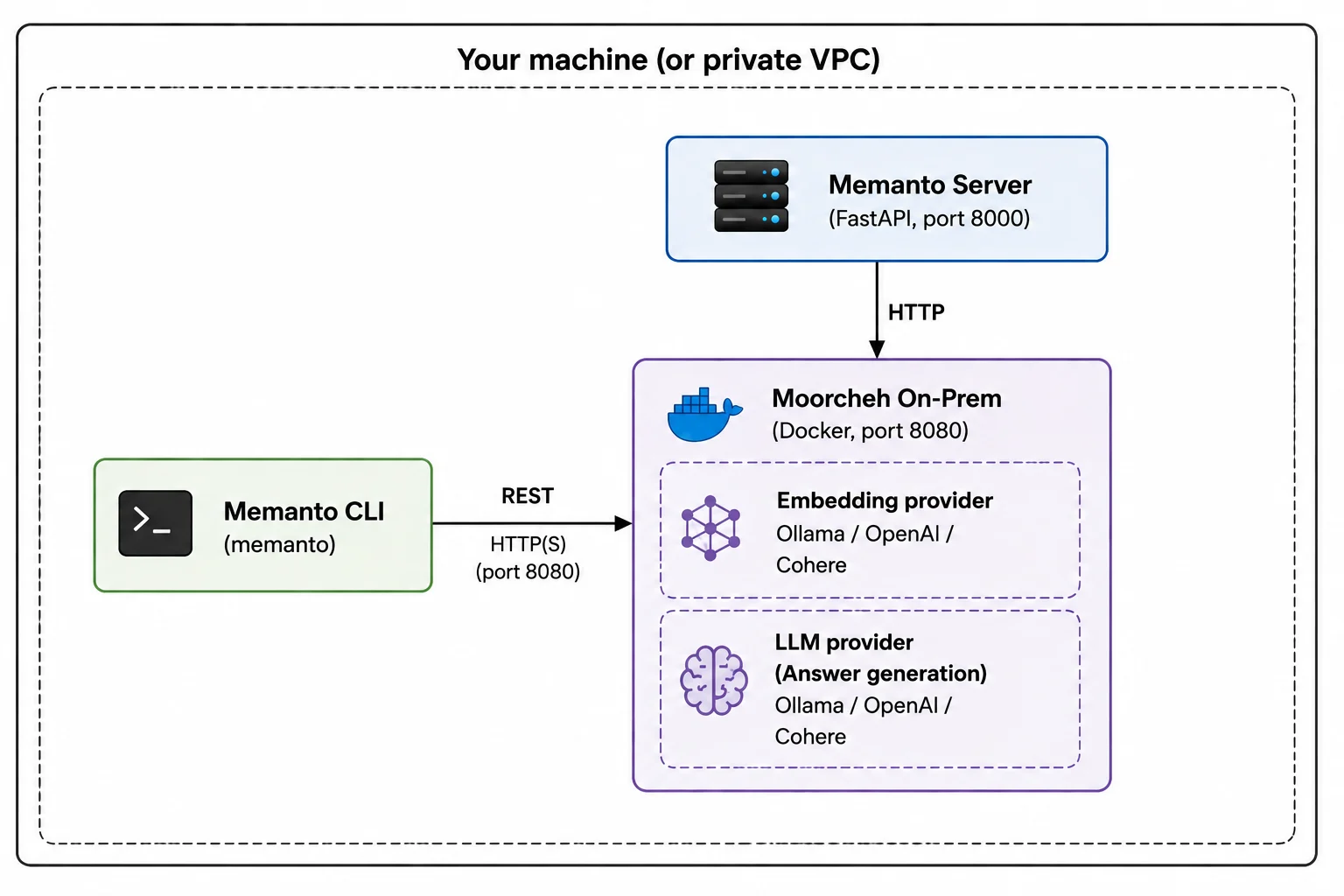
 ## On-Prem
 ## Deployment Options
* **Cloud (default)**: Talk to Moorcheh Cloud with a single API key — zero install, instant retrieval.
* **On-Prem**: Run the full stack (Memanto + Moorcheh server + optional Ollama) on your own hardware. No API key, no data leaves your network. See [On-Prem Overview](/on-prem/overview).
* **Docker**: Fastest setup, reproducible environments
* **Python**: Development and customization
* **Kubernetes / Cloud Platforms**: AWS ECS, Google Cloud Run, Azure Container Instances, or self-managed K8s.
* **Local**: Single machine testing and prototyping
## Next Steps
Choose your path based on your use case:
* ** Using Memanto CLI?** → See [Installation & Quickstart](./installation)
* ** Integrating with an agent?** → See [Agent Integration](./quickstart-api)
* ** Building a Node.js app?** → See [TypeScript SDK Reference](/sdk/typescript)
* ** Need complete reference?** → See [API Reference](/api-reference/authentication)
***
## Need Help?
* **Docs**: Full documentation on Moorcheh [https://docs.moorcheh.ai](https://docs.moorcheh.ai)
* **Discord**: Join the community at [https://memanto.ai/discord](https://memanto.ai/discord)
* **Email**: [support@moorcheh.ai](mailto:support@moorcheh.ai)
## Deployment Options
* **Cloud (default)**: Talk to Moorcheh Cloud with a single API key — zero install, instant retrieval.
* **On-Prem**: Run the full stack (Memanto + Moorcheh server + optional Ollama) on your own hardware. No API key, no data leaves your network. See [On-Prem Overview](/on-prem/overview).
* **Docker**: Fastest setup, reproducible environments
* **Python**: Development and customization
* **Kubernetes / Cloud Platforms**: AWS ECS, Google Cloud Run, Azure Container Instances, or self-managed K8s.
* **Local**: Single machine testing and prototyping
## Next Steps
Choose your path based on your use case:
* ** Using Memanto CLI?** → See [Installation & Quickstart](./installation)
* ** Integrating with an agent?** → See [Agent Integration](./quickstart-api)
* ** Building a Node.js app?** → See [TypeScript SDK Reference](/sdk/typescript)
* ** Need complete reference?** → See [API Reference](/api-reference/authentication)
***
## Need Help?
* **Docs**: Full documentation on Moorcheh [https://docs.moorcheh.ai](https://docs.moorcheh.ai)
* **Discord**: Join the community at [https://memanto.ai/discord](https://memanto.ai/discord)
* **Email**: [support@moorcheh.ai](mailto:support@moorcheh.ai)